Finance
SIP vs FD: Which Is Better?
By Team DIRECTIV · · 4 min read
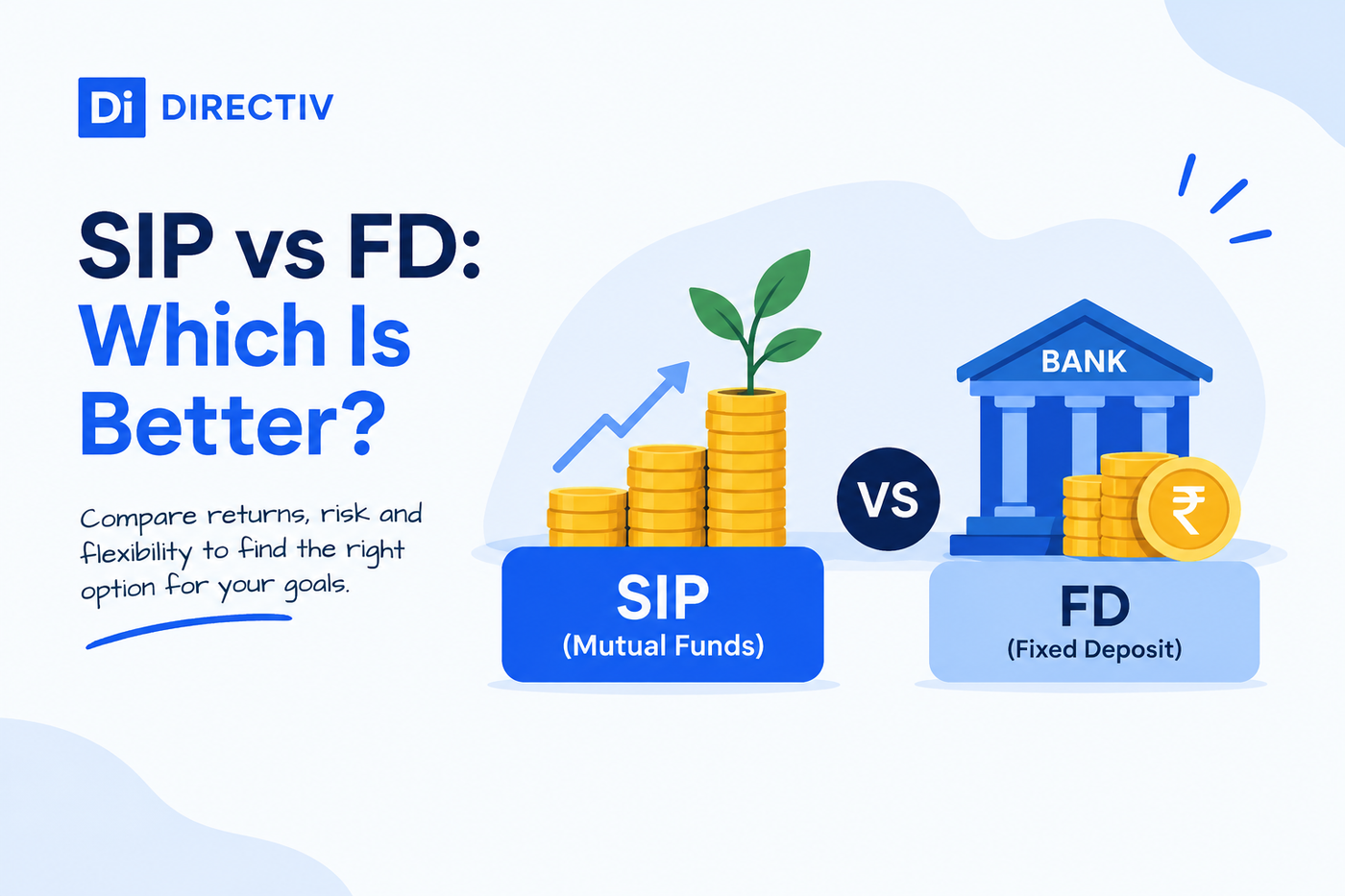
What Is SIP and What Is FD?
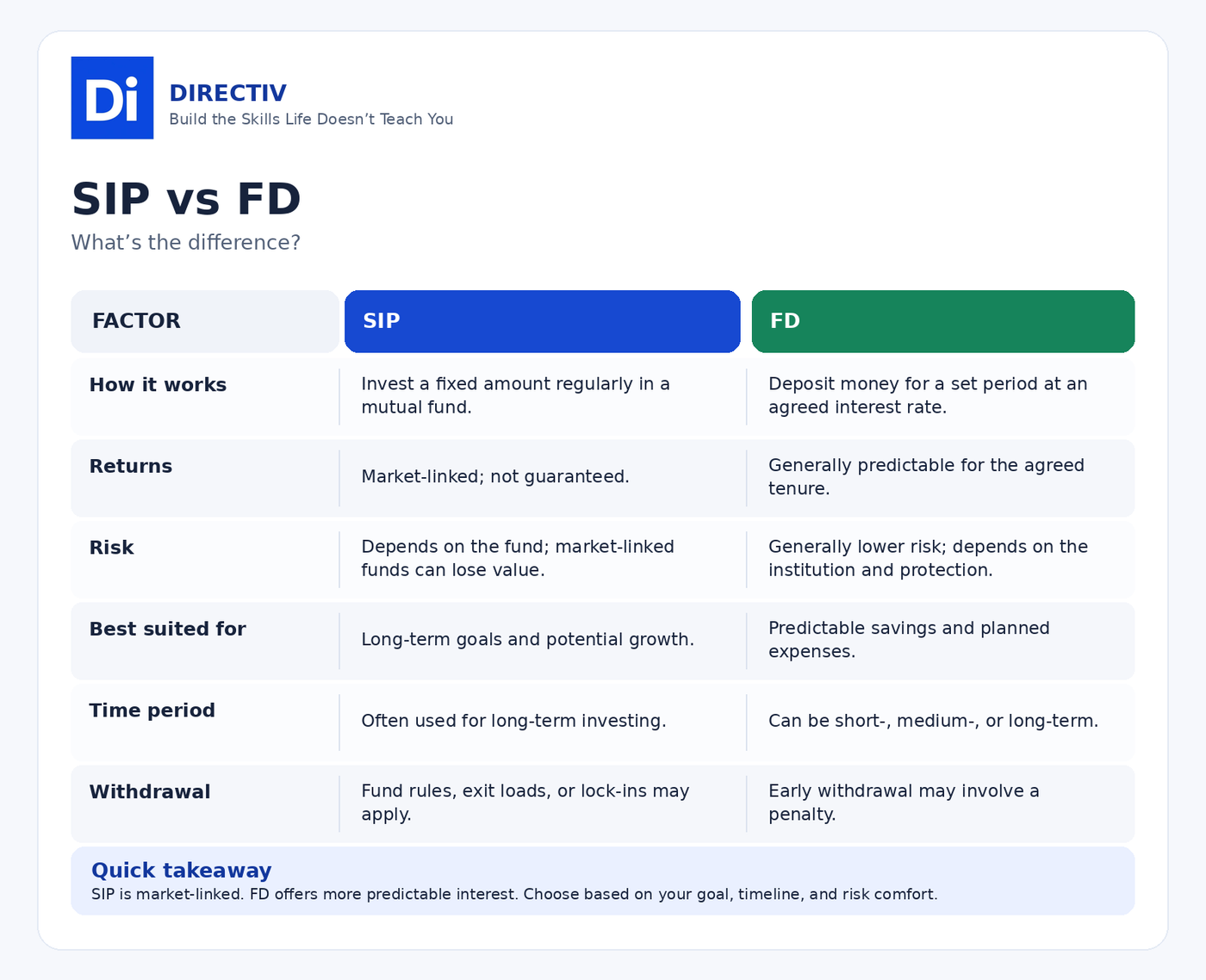
A SIP (Systematic Investment Plan) is a way to invest a fixed amount regularly in a mutual fund, usually every month. If the fund invests in the stock market, your returns depend on market performance.
A Fixed Deposit (FD) is an investment where you deposit money with a bank or eligible financial institution for a specific period at an agreed interest rate.
The right choice depends on when you need the money, how much risk you can handle, and what you want to achieve from your investment.
What Is the Difference Between SIP and FD?
Is SIP Better Than FD?
Both have their own pros and cons. SIP may be suitable if you are investing for long-term goals and can handle market fluctuations. An FD may be more suitable if you want predictable returns and lower risk.
It depends on whether you need the money in the short term or long term, whether you can afford investment losses, and what you want to achieve.
What Should You Choose: SIP, FD, or Both?
Before deciding, ask yourself these five questions:
- How long can I keep my money invested? If you need it soon, an FD may be more suitable. SIPs in market-linked funds are generally better suited to longer-term goals.
- Can I handle the risk of losing money? If market fluctuations make you uncomfortable, an FD may suit you better.
- Do I need predictable returns? FD interest rates are generally fixed for the agreed tenure, while SIP returns depend on mutual fund performance.
- What is my financial goal? For planned expenses and predictable savings, consider an FD. For long-term wealth creation, consider an appropriate mutual fund SIP.
- Do I have emergency savings? Before investing for long-term growth, keep some money accessible for unexpected expenses.
Can you choose both? Yes. You can use an FD for predictable savings and a SIP for long-term investment, depending on your financial situation and goals.
If you are still confused about how to manage your money, understanding basic financial concepts can help you make better decisions. At Directiv, we focus on practical financial learning so students can understand money, investments, and financial decisions before making them.
SIP vs FD: Which Can Give Higher Returns?
A SIP in an equity mutual fund has the potential to generate higher returns over the long term, but returns are not guaranteed and losses are possible. An FD offers more predictable interest for its agreed tenure. The better option depends on your time horizon, risk tolerance, and financial goals.
Can You Start a SIP With ₹500?
Yes, you can start a SIP with ₹500 per month in mutual funds that allow that minimum investment. The minimum amount depends on the specific scheme.
Starting small can help you build an investing habit, but your returns will depend on the fund's performance and how long you invest. Check the scheme details and risks before investing.
Is FD Safer Than SIP?
Generally, an FD offers more predictable returns and lower risk than a market-linked mutual fund SIP. However, the safety of an FD depends on the institution and applicable protections.
In India, eligible bank deposits are insured by DICGC up to ₹5 lakh per depositor per bank, including principal and interest, subject to its rules. Mutual fund investments are not covered by this deposit insurance.
Should a Beginner Choose SIP, FD, or Both?
If you are a beginner, first understand your goal and how much risk you can handle. An FD may suit you if you prioritise predictable returns, while a SIP may suit you if you have a longer time horizon and can handle market fluctuations.
You can also use both for different goals instead of choosing only one.
Frequently Asked Questions
Is SIP riskier than FD?
A SIP in a market-linked mutual fund carries investment risk, while an FD generally offers more predictable returns. The level of SIP risk depends on the mutual fund you choose.
Can I withdraw money from a SIP anytime?
Many open-ended mutual funds allow withdrawals, but exit loads, settlement times, or scheme-specific restrictions may apply. Some funds also have lock-in periods.
Is SIP suitable for short-term goals?
Market-linked SIPs may not be suitable for money you need very soon because markets can fall when you need to withdraw. Choose investments based on your goal and time horizon.
Do FDs guarantee returns?
An FD generally offers an agreed interest rate for its tenure, subject to its terms and the institution's ability to meet its obligations. Deposit insurance applies only to eligible deposits within the applicable limits.
Conclusion
SIP and FD serve different purposes, so neither is automatically better for everyone. Choose based on your financial goal, investment period, and ability to handle risk. If it suits your situation, you can use both to balance predictable savings with long-term growth.
At Directiv, through our Decoding Finance learning track, students can explore personal finance, saving, investing, and wealth creation in a practical way. Because making better financial decisions starts with understanding your money.
Ready to build real-world skills?
Join DIRECTIV and start your journey in finance, content and communication.
Get in Touch