General
Physical Gold vs Gold ETF vs SGB: Costs, Returns, Tax and Which Is Better in India?
By Team DIRECTIV · · 13 min read
Introduction
Today, buying jewellery is not the only option to invest in gold. We can invest in gold in multiple ways, such as gold coins, Gold ETFs, gold mutual funds and more.
Digital gold is also an option, but it comes with its own pros and cons. So, deciding which gold investment option is better is an important question.
In this article, you will learn about the different ways to invest in gold, their costs, risks and benefits, and how to choose the right option for yourself.
Let's understand everything step by step.
If you are new to gold investing, first read our guide on how to invest in gold in India.
1. Physical Gold vs Gold ETF vs SGB: Which Is Better?
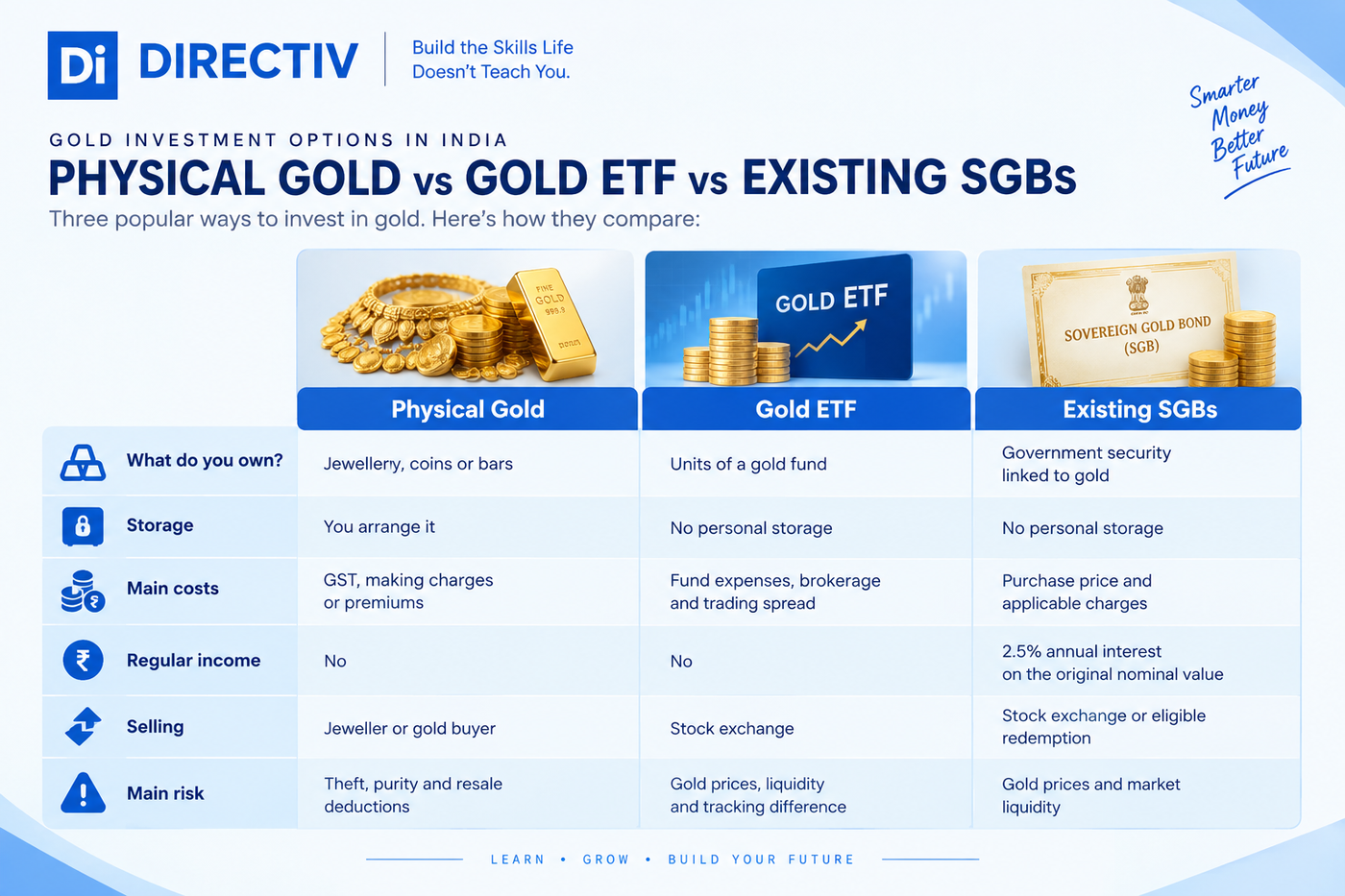
Physical gold gives you gold in the form of jewellery, coins or bars. Gold ETFs let you invest in gold through the stock market, while Sovereign Gold Bonds (SGBs) are government securities linked to gold prices.
Which option should you choose?
- Want gold to wear? Physical gold may be suitable.
- Want gold investment without storing it? Compare Gold ETFs and gold mutual funds.
- Want to consider an SGB? Check its market price, remaining maturity, interest and tax treatment before buying.
Fresh SGB issuance has not appeared in the government's published issuance schedule since February 2024. Existing bonds may still be available on stock exchanges, but their prices can differ from the value linked to gold. Check the RBI's SGB information for updates.
2. What Does It Actually Cost to Invest in Gold?
The gold price you see is not always the final amount you pay. Extra charges and the difference between buying and selling prices can reduce your returns.
- Jewellery: You generally pay 3% GST on the gold value and 5% GST on making charges, where applicable.
- Coins and bars: Premiums, GST and resale deductions can affect your returns.
- Gold ETFs: Check the expense ratio, brokerage, trading spread and tracking difference.
- Gold mutual funds: Check the expense ratio and any applicable exit load.
- Digital gold: Check the buying and selling prices, GST, delivery charges and other fees.
- SGBs: Compare the market price with the gold-linked redemption value and check the remaining maturity.
For example, if you buy gold at a higher price and sell it at a lower rate, your profit may be smaller than the rise in gold prices suggests.
Always compare the total cost, not just the gold rate.
3. Gold ETF vs Gold Mutual Fund: Which Is Better?
A Gold ETF may suit someone who has a demat account and wants to trade through a stock exchange. A gold mutual fund may be more convenient if you want to invest through a mutual fund platform without opening a demat account.
A Gold ETF tracks gold prices, while a gold mutual fund generally invests in Gold ETFs or other gold-linked instruments.
Before choosing, compare the expense ratio, tracking difference, minimum investment, liquidity and exit load.
What are GLD, IAU and GOLDBEES?
- GLD and IAU: US-listed gold ETFs.
- GOLDBEES: An India-listed Gold ETF.
Do not choose an ETF just because it is popular. Compare its costs, liquidity and how closely it tracks gold prices. US-listed funds may also involve currency movements, overseas-investment requirements and additional tax considerations for Indian residents.
For many beginners in India, domestic gold ETFs and gold mutual funds are easier options to compare first.
4. Is Digital Gold Safe in India?
Digital gold allows you to buy small quantities of gold online, but it does not have the same securities-market regulatory protections as a SEBI-regulated Gold ETF or gold mutual fund.
Before investing, check who holds the gold, how its purity is verified, where it is stored, the buying-selling price difference and the charges for delivery or redemption.
SEBI issued a public caution about online digital-gold products on 8 November 2025, highlighting that these products fall outside its securities-market regulatory framework and may involve counterparty and operational risks. Read the official SEBI warning on digital gold before deciding.
5. What Makes Gold Prices Go Up or Down?
Gold prices depend on several factors, including interest rates, inflation expectations, the US dollar, central-bank purchases and global uncertainty. No single factor can predict exactly where prices will go next.
Does gold always rise during inflation?
No. Gold may help investors diversify during inflation, but its price also depends on interest rates, currency movements and investor demand.
What happens when central banks cut interest rates?
Lower interest rates can support gold because gold does not pay regular interest like a bank deposit. However, other market factors can still push gold prices down.
How does the US dollar affect gold prices?
Gold is commonly priced internationally in US dollars. A stronger dollar can put pressure on gold prices, while a weaker dollar may support them, although this relationship is not guaranteed.
For Indian investors, the rupee-dollar exchange rate also matters. A weaker rupee can increase domestic gold prices even when international gold prices change less.
Why do central banks buy gold?
Central banks hold gold to diversify their reserves and manage long-term financial risks. Strong central-bank demand can support prices, but it does not guarantee future gains.
For gold-demand research and market data, visit the World Gold Council.
Does gold always rise during wars or stock-market crashes?
No. Gold may attract investors during uncertainty, but it can also fall when investors sell assets to raise cash. Gold and stocks can sometimes decline together during a market shock.
Does gold become expensive during festivals?
Demand may increase around weddings, Dhanteras and Diwali, but seasonal demand does not guarantee higher prices. Global prices, interest rates and currency movements also matter.
6. Should You Buy Gold at an All-Time High or Wait for a Dip?
Buying gold at an all-time high is not automatically a mistake, but prices can fall after reaching a peak. Waiting for a dip is not guaranteed to work either.
You can consider three approaches:
- Monthly investment: Invest a fixed amount regularly.
- Lump sum: Invest the full amount at once.
- Staggered investment: Divide your planned investment into smaller purchases over a chosen period.
Regular investing spreads purchases across different prices, but it does not guarantee profit or prevent losses.
Is gold better for short-term or long-term goals?
If you need your money in one to three years, a sudden fall in gold prices could affect your plans. A longer time horizon gives you more time to handle price changes, but gold returns are still not guaranteed.
Choose your investment according to when you need the money, not just recent price increases.
7. How Much of Your Portfolio Should Be in Gold?
There is no fixed percentage that is right for everyone. Your gold allocation depends on your goals, existing investments, time horizon and ability to handle losses.
Some investors use 5–10% as an illustrative starting range for diversification, but this is not a universal rule.
Before investing, check whether you have emergency savings, whether you have high-interest debt and whether you will need the money soon.
Gold can diversify a portfolio, but putting too much money into a single asset can increase risk. Read our guide to beginner investing to understand how different investments can fit together.
8. How Can You Check Gold Purity?
In India, check the BIS hallmark, purity marking and six-character Hallmark Unique Identification (HUID) on hallmarked jewellery. You can verify the HUID through the BIS Care app.
Common purity levels include:
- 24K: Very high-purity gold, commonly used for investment bars and some coins.
- 22K: Approximately 91.6% gold, often marked 916.
- 18K: 75% gold, often marked 750.
Before buying, ask for an invoice showing the weight, purity, price and applicable charges. For more information, visit the Bureau of Indian Standards.
9. Gold Coins vs Gold Bars: Which Is Better?
Gold coins may be easier to sell in smaller quantities, while larger bars may have lower premiums per gram.
However, smaller coins can cost more per gram, and larger bars may be less convenient if you need to sell only part of your investment.
Compare the final price per gram, purity, seller reputation and buyback policy before purchasing.
10. Where Should You Store Physical Gold?
Your storage choice depends on the value of your gold, security needs, access and total cost.
- Home safe: Convenient, but theft remains a risk.
- Bank locker: Offers controlled storage but involves fees and access conditions.
- Professional vault: May offer specialised custody, but check storage fees, insurance and withdrawal rules.
Do not assume your home or renters insurance automatically covers all your gold. Check policy limits, exclusions and whether additional coverage is required.
For smaller investments, a Gold ETF may be simpler than arranging physical storage.
11. How Is Gold Taxed in India?
Gold taxation depends on the investment type, acquisition date, holding period and how you sell or redeem it. Physical gold, Gold ETFs, gold mutual funds and SGBs do not all follow the same tax rules.
How is physical gold taxed?
For physical gold held for more than 24 months, long-term capital gains are generally taxed at 12.5% without indexation. Gains on gold held for 24 months or less are generally taxed at your applicable income-tax slab rates.
How are Gold ETFs taxed?
For listed Gold ETFs, gains on units held for more than 12 months are generally taxed at 12.5% without indexation. Short-term gains are generally taxed at applicable slab rates.
How are gold mutual funds taxed?
The treatment depends on the fund's structure, acquisition date and applicable tax provisions. Do not assume that every gold mutual fund follows the same rules as a Gold ETF.
Are Sovereign Gold Bonds tax-free?
Not in every situation. Under the provisions effective from 1 April 2026, the capital-gains exemption on redemption at maturity is restricted to eligible individual investors who subscribed at the original issue and held the bonds continuously until maturity. Buying an SGB in the secondary market does not qualify for this exemption.
SGB interest is generally 2.5% annually on the original nominal investment value, paid according to the bond terms. Interest income and capital gains are treated separately for tax purposes.
Tax rules can change, so check the Income Tax Department's official website before selling or redeeming gold. For significant transactions, consult a qualified tax professional.
12. Are Gold Mining Stocks and Covered-Call Funds Better?
Gold mining stocks are not the same as investing directly in gold. Their performance also depends on company costs, debt, production and management.
For example, GDX provides exposure to gold-mining companies, which may rise more than gold in some periods but can also fall more sharply.
Covered-call funds use options strategies to generate income but may give up some potential gains. A high distribution does not automatically mean a higher total return.
These products are more complex than ordinary Gold ETFs, so beginners should understand their costs and risks first.
13. Gold vs Silver vs Platinum vs Bitcoin
These assets have different uses and risks, so none is automatically the best investment.
- Gold: Used for jewellery, investment and central-bank reserves.
- Silver: Has both investment and industrial demand.
- Platinum: Has significant industrial uses and its own supply-demand cycle.
- Bitcoin: A digital asset that can experience high price volatility and technology-related or regulatory risks.
Do not invest just because an asset has recently risen in price. Understand what you are buying and how much risk you can afford.
14. What If You Had Invested ₹10,000 in Gold 10 Years Ago?
A ₹10,000 investment in gold in October 2016 could have been worth approximately ₹47,000 by 23 October 2026, based on illustrative benchmark prices of ₹30,071 and ₹1,41,630 per 10 grams, respectively. This calculation excludes costs and taxes and is not the exact return from a particular investment product. <Cite refs={["turn923958search1","turn923958search2"]}/>
For example:
- Initial investment: ₹10,000
- Illustrative value after 10 years: Around ₹47,000
- Illustrative gain: Around ₹37,000
The actual result depends on the exact purchase and selling dates, product, charges and taxes. Jewellery may involve making charges and resale deductions, while Gold ETFs have expenses and tracking differences.
The lesson is simple: gold has delivered strong gains in some periods, but it can also fall. Past performance does not guarantee future returns.
15. How Can You Sell Gold at a Fair Price?
The amount you receive depends on purity, weight, the current gold rate and the buyer's deductions. Compare offers before selling.
For physical gold:
- Check the purity and weight.
- Get quotes from more than one reputable buyer.
- Ask for a breakdown of deductions.
- Keep your invoice and purity documents.
- Compare the final amount offered.
Jewellery making charges are generally not recovered in full. Coins and bars can also have resale deductions.
For Gold ETFs, check the market price, trading spread and liquidity. For SGBs, compare the market price with the applicable redemption terms and remaining maturity.
Frequently Asked Questions
Is gold a safe investment?
Gold can help diversify your portfolio, but its price can fall. It is not risk-free and does not guarantee profit.
Is it better to invest in gold monthly or all at once?
Monthly investing spreads purchases across different prices, while a lump sum invests immediately. Neither approach guarantees better returns.
Is digital gold better than a Gold ETF?
Gold ETFs operate within the SEBI-regulated securities framework, while online digital-gold products do not receive the same securities-market protections. Compare costs, custody, liquidity and risks.
Is buying gold at an all-time high a bad decision?
Not necessarily. Prices may correct or continue rising, so consider your investment timeline and planned allocation instead of trying to predict every price movement.
Is a bank locker better than a home safe?
It depends on your security needs, access requirements, fees and insurance. Compare the total cost and protection before deciding.
Do I pay tax when selling gold?
Tax may apply depending on the investment type, acquisition date, holding period and transaction. Check the current rules before selling.
Are Gold ETFs suitable for beginners?
They may suit beginners who understand market-linked investments. Compare fees, tracking differences and liquidity before investing.
Final Thoughts
There is no single gold investment option that is best for everyone.
If you want jewellery or physical ownership, consider coins, bars or jewellery while checking purity and charges. If you want gold exposure without personal storage, compare Gold ETFs and gold mutual funds. If you are considering an SGB, check its price, maturity, interest and tax rules first.
Do not choose an investment only because gold prices are rising. Compare the costs, understand the risks and invest according to your goals.
At DIRECTIV, we aim to make financial concepts simple and practical so readers can make more informed decisions.
If you actually want to learn personal finance and make better financial decisions, you can learn through Directiv’s interactive learning platform, where you develop practical, real-life skills that help you manage your money and make informed decisions.
Disclaimer: This article is for educational purposes only. It is not financial, investment or tax advice. Gold prices can rise or fall. Verify current product terms and tax rules before investing.
Author Bio:
CA Umang Mahra is a Chartered Accountant and co-founder of Directiv, a life-skills learning platform. His expertise includes investing, stock research, business fundamentals, and company valuations. Through his work, he aims to help young learners develop financial literacy, make informed financial decisions, and build a strong foundation for long-term wealth creation.
LinkedIn: https://www.linkedin.com/in/ca-umang-mahra-56a0b4151/
Ready to build real-world skills?
Join DIRECTIV and start your journey in finance, content and communication.
Get in Touch