General
Mastering Storytelling: 7 Proven Frameworks to Engage Any Audience
By Team DIRECTIV · · 10 min read
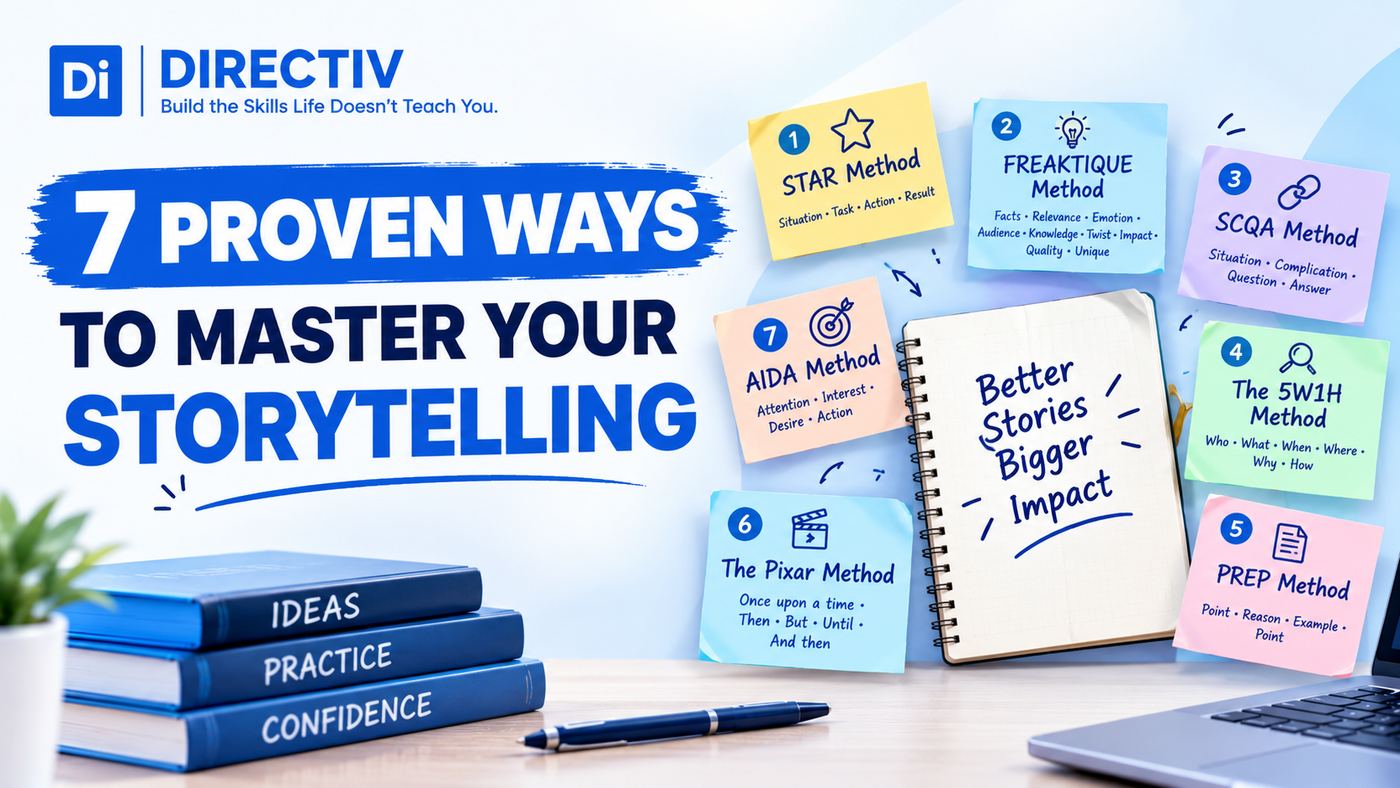
Mastering Storytelling: 7 Proven Frameworks to Engage Any Audience
People don't listen to your story, they interrupt you in between. Have you ever wondered why? Many times, the story itself is not bad, but the way you are presenting it is definitely wrong.
In storytelling, one of the most important things is the way you deliver your story. Everyone has different experiences and stories to share, but everyone does not know how to present them in a way that keeps people interested.
In this article, you will learn 7 proven storytelling frameworks that can help you present your ideas better and make people interested in what you are saying.
At Directiv, we focus on helping students learn skills that actually matter in real life through personalised guidance and practical learning rather than only theoretical knowledge. Storytelling is one such skill that can help you communicate your thoughts with more clarity and confidence.
First, Let's Understand What Storytelling Is
Storytelling is basically the art of presenting events, experiences, or ideas in a way that helps people understand and connect with them. If someone can visualise what you are narrating, follow your story, and understand what you are trying to explain, you are using storytelling effectively.
Now, let's understand seven storytelling frameworks that can help you do this better.
1. The Three-Act Structure: How to Give Your Story a Clear Beginning, Middle, and End
The Three-Act Structure is one of the most widely used approaches to storytelling. It divides a story into three parts: the setup, the confrontation, and the resolution.
This framework is useful when you have an experience to share but do not know how to organise it properly.
How does it work?
- Beginning: Introduce the situation and explain what is happening.
- Middle: Explain the problem, challenge, or conflict.
- End: Show what happened and how the situation changed.
Example:
Suppose you want to tell someone about your first job interview.
In the beginning, you explain how you prepared for the interview. In the middle, you describe how you struggled with a question you were not expecting. At the end, you explain how you handled the situation and what you learned from it.
See how a simple experience becomes easier to follow when it has a clear structure?
Whenever you feel confused about how to start or end a story, try this framework.
2. The Hero's Journey: How to Make Your Story About Growth
The Hero's Journey is a storytelling framework in which a character leaves their familiar situation, faces challenges, and returns having changed in some way.
It is commonly associated with adventure stories, but the basic idea can also help you explain personal growth.
How does it work?
Your story begins with a familiar situation. Something challenges you, you try to overcome it, and the experience changes the way you think or act.
Example:
Imagine a student who is afraid of public speaking. Initially, they avoid presentations because they are worried about making mistakes. Eventually, they decide to participate in a college event. They struggle at first, practise, and gradually become more comfortable speaking in front of people.
The interesting part is not just that the student participated in an event. It is how they moved from avoiding a challenge to facing it.
This framework works well when you want to talk about personal development, overcoming difficulties, or learning something new.
3. The Pixar Story Spine: How to Make Your Story Flow Naturally
The Story Spine is a simple storytelling structure often associated with Pixar's storytelling practice. It helps you connect events in a logical sequence instead of presenting random incidents.
It follows a simple pattern: once upon a time, every day, one day, because of that, because of that, until finally.
How does it work?
You introduce the character or situation, explain what changes, show the consequences, and then bring the story to a conclusion.
Example:
Once upon a time, a student wanted to start creating videos. Every day, they watched other creators and planned their own content. One day, they finally uploaded their first video. Because very few people watched it, they felt disappointed. Because they wanted to improve, they started studying their openings and practising their delivery. Eventually, they became more confident about creating content.
Notice how every event leads to the next one.
This framework is especially useful when your story feels disconnected or when you have many things to explain but do not know how to connect them.
4. The Problem-Agitate-Solution Framework: How to Make People Care About a Problem
The Problem-Agitate-Solution framework, often called PAS, is commonly used in persuasive writing and marketing communication. It starts with a problem, explains why it matters, and then presents a solution.
It can also help you explain an experience when your main purpose is to show how a problem was solved.
How does it work?
First, explain the problem. Then show its consequences. Finally, explain what can be done about it.
Example:
Imagine you are explaining why students struggle with managing their money.
The problem is that many students do not track their spending. As a result, they may run out of money before the month ends without understanding where it went. A practical solution is to track expenses, separate needs from wants, and plan a budget.
The audience understands the issue because you have explained not just the problem, but also why it matters.
Use this framework when you are explaining a challenge, teaching a practical skill, or creating educational content.
5. Before-After-Bridge: How to Show the Difference Your Idea Can Make
The Before-After-Bridge framework helps you show the difference between a situation before a change and the situation afterwards, with the bridge explaining how the change happened.
It is particularly useful when you want to communicate improvement without making the story unnecessarily complicated.
How does it work?
- Before: Explain the initial situation.
- After: Show what the improved situation looks like.
- Bridge: Explain the action or change that connects the two.
Example:
Before: A student struggles to explain their ideas during presentations.
After: The student can organise their thoughts and explain them more clearly.
Bridge: They start practising with a simple structure, recording themselves, and improving based on feedback.
This framework makes the benefit of an action easier to understand. It can be used in educational content, presentations, personal branding, and explanations of how a skill can improve with practice.
Remember, if you use it to describe a real result, the result should be genuine. A hypothetical example should not be presented as a real success story.
6. Freytag's Pyramid: How to Build Tension and Keep People Interested
Freytag's Pyramid is a traditional story structure that explains how tension develops and resolves. Its five main stages are exposition, rising action, climax, falling action, and resolution.
This framework is useful when you want to make a story feel more engaging instead of revealing everything at the beginning.
How does it work?
You introduce the situation, build towards a challenge, reach the most intense moment, show the consequences, and finally resolve the story.
Example:
Imagine a student participating in a college competition.
First, you introduce the student and the competition. Then you explain how the student prepares and faces difficulties during practice. The climax comes when the student has to deliver the final presentation. After that, you describe what happens following the presentation and how the experience ends.
The important part is building towards the main moment instead of rushing through the entire experience.
This framework is especially useful for fictional stories, longer personal experiences, and narratives where tension plays an important role.
7. The STAR Method: How to Tell Better Stories in Interviews
The STAR method stands for Situation, Task, Action, and Result. It is widely used to organise answers to behavioural interview questions, especially questions about teamwork, problem-solving, and handling challenges.
If you have ever struggled to answer an interview question because you did not know how to explain your experience, this method can help.
How does it work?
- Situation: What was happening?
- Task: What responsibility or challenge did you face?
- Action: What did you do?
- Result: What happened because of your actions?
Example:
Suppose an interviewer asks you to describe a time you worked in a team.
You explain that your college team had a project with a tight deadline. Your responsibility was to coordinate the research. You divided the work into smaller tasks and regularly checked progress with your teammates. As a result, the team submitted the project on time.
The answer becomes clear because you are giving a specific example rather than simply saying that you are good at teamwork.
The STAR method is particularly useful for students, freshers, and professionals preparing for interviews.
Which Storytelling Framework Should You Use?
Not every framework is suitable for every situation. The best choice depends on what you want your audience to understand.
Framework
Best used for
Three-Act Structure
Organising a story from beginning to end
Hero's Journey
Showing personal growth and overcoming challenges
Pixar Story Spine
Connecting events in a natural sequence
Problem-Agitate-Solution
Explaining a problem and presenting a solution
Before-After-Bridge
Showing how a situation can change
Freytag's Pyramid
Building tension in a narrative
STAR Method
Answering interview questions with real examples
You do not need to learn all seven frameworks at once. Start with the one that matches your purpose and practise it until organising your thoughts becomes easier.
Conclusion: Storytelling Is a Skill You Can Practise
A good story is not always about having an extraordinary experience. Sometimes, it is about explaining an ordinary experience in a way that helps someone understand why it matters.
The next time you tell a story, think about what you want the listener to understand. Give your story a clear structure, include the details that matter, and avoid making people work too hard to follow your point.
Start with one framework and practise it in your everyday conversations, college presentations, interviews, or content creation. Over time, you can learn which techniques work best for different situations.
At Directiv, we believe that practical skills become valuable when you learn them, practise them, and apply them in real life. If you want to develop skills such as storytelling, communication, and content creation, Directiv aims to help you build them through practical learning and personalised guidance.
Learn the skill. Practise it. Use it in real life.
Frequently Asked Questions
What are the best storytelling frameworks for beginners?
The Three-Act Structure and Pixar Story Spine are useful starting points because they help you organise events in a clear sequence. The STAR method is another practical option for students preparing for interviews.
How can I become a better storyteller?
Start by choosing one main point, organising your story into a clear sequence, using relevant details, and practising how you deliver it. Asking for feedback can help you understand where your story becomes confusing or loses the listener's interest.
Is storytelling useful for career development?
Yes. Storytelling can help you explain your experiences in interviews, communicate ideas during presentations, share knowledge with colleagues, and create engaging content. Its usefulness depends on how well you adapt the story to the situation.
Can storytelling be learned, or is it a natural talent?
Storytelling can be learned and improved through practice. Some people may feel more comfortable telling stories naturally, but structure, clarity, and delivery can all be developed over time.
About the Author
Shivam Pandey is the Founder of Directiv, a career coach with over four plus years of experience, and a content creator. He focuses on helping learners develop practical skills, communicate their ideas effectively, and prepare for real-world challenges beyond traditional education. Through Directiv, he advocates for learning by doing and building skills that people can apply in their everyday lives.
Connect with Shivam on LinkedIn.
Ready to build real-world skills?
Join DIRECTIV and start your journey in finance, content and communication.
Get in Touch