Finance
Credit Card vs UPI vs Cash: Which Is Better for Everyday Spending?
By Team DIRECTIV · · 6 min read
In our day-to-day activities, we have multiple options for making payments. But the question is, which one is better?
Let's understand the difference between cash, UPI and credit cards, along with their advantages and disadvantages.
1. Cash
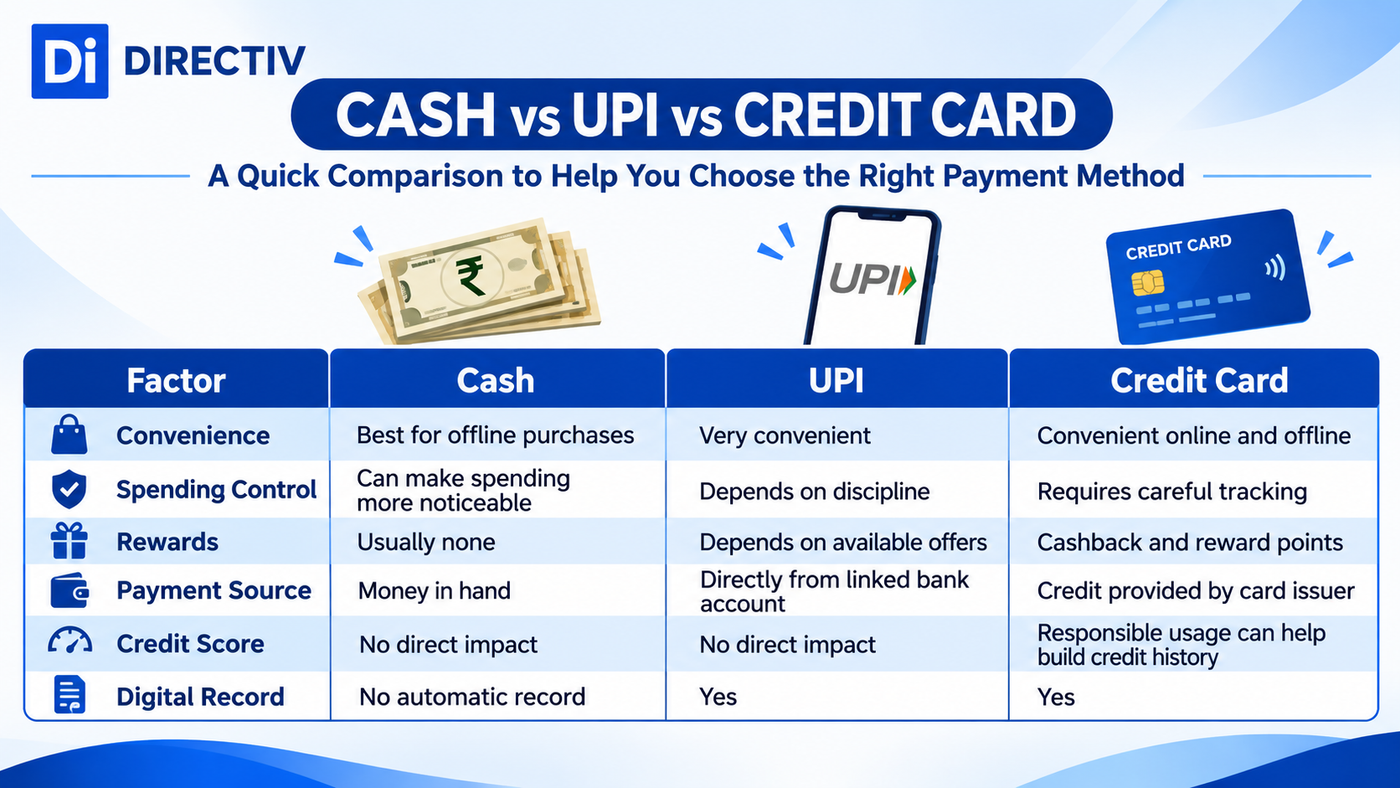
Cash is one of the simplest ways to make payments. It can also help you become more aware of your spending because you can actually see how much money you are spending.
According to research, people tend to spend a little more when they use cashless payment methods compared to cash. This is known as the Cashless Effect.
A 2024 study published in the Journal of Retailing, which analysed 71 research papers, also found a small but significant increase in spending when people used cashless payment methods instead of cash.
Advantages of using cash:
- Better spending control: When you carry a fixed amount of cash, it becomes easier to control unnecessary expenses.
- No internet required: You can make payments without a smartphone, internet connection or banking app.
- Widely accepted: Cash is useful for small purchases, local shops and places where digital payments are not available.
Disadvantages of using cash:
- Difficult to track expenses: You don't get an automatic record of your transactions, which can make tracking spending difficult.
- Risk of loss or theft: If you lose your cash, getting it back can be difficult.
- Not suitable for online payments: You cannot directly use physical cash for most online purchases.
2. UPI (Unified Payments Interface)
UPI allows you to transfer money directly between bank accounts within seconds using UPI apps. You can make payments by scanning a QR code, entering a UPI ID or selecting a saved contact.
Advantages of using UPI:
- Quick and convenient: You can make payments within seconds without carrying cash.
- Easy expense tracking: Every transaction is recorded digitally, making it easier to check where your money is going.
- Available 24/7: You can make UPI payments at any time, including weekends and holidays.
- No need to share bank details: You can make payments using a UPI ID or QR code instead of sharing your bank account number.
Disadvantages of using UPI:
- Internet dependency: Most UPI payments require a working smartphone and internet connection.
- Risk of online fraud: Scammers may trick you into sharing your UPI PIN or approving a payment request.
- Wrong transfers can be difficult to reverse: If you send money to the wrong UPI ID, getting it back is not guaranteed.
- Easy to make unnecessary purchases: Since payments are so quick, you may end up spending small amounts frequently without realising how much they add up to.
3. Credit Card
A credit card allows you to make payments using a credit limit provided by the bank. Unlike UPI, where money is deducted directly from your bank account, a credit card lets you make payments now and repay the amount later.
Advantages of using a credit card:
- Cashback and rewards: Many credit cards offer cashback, reward points and discounts on eligible purchases.
- Payment flexibility: You get time to repay your expenses instead of paying immediately.
- Builds credit history: Using a credit card responsibly and paying bills on time can help build your credit score.
- Useful for online shopping: Credit cards are widely accepted on shopping websites and can offer additional purchase protection, depending on the card.
Disadvantages of using a credit card:
- Risk of overspending: Since money is not deducted immediately, you may spend more than you can afford.
- High interest charges: If you don't pay your full bill by the due date, interest and other charges may apply.
- Annual and other fees: Some credit cards have joining fees, annual fees and other charges.
- Can affect your credit score: Late payments and high credit utilisation can negatively affect your credit history.
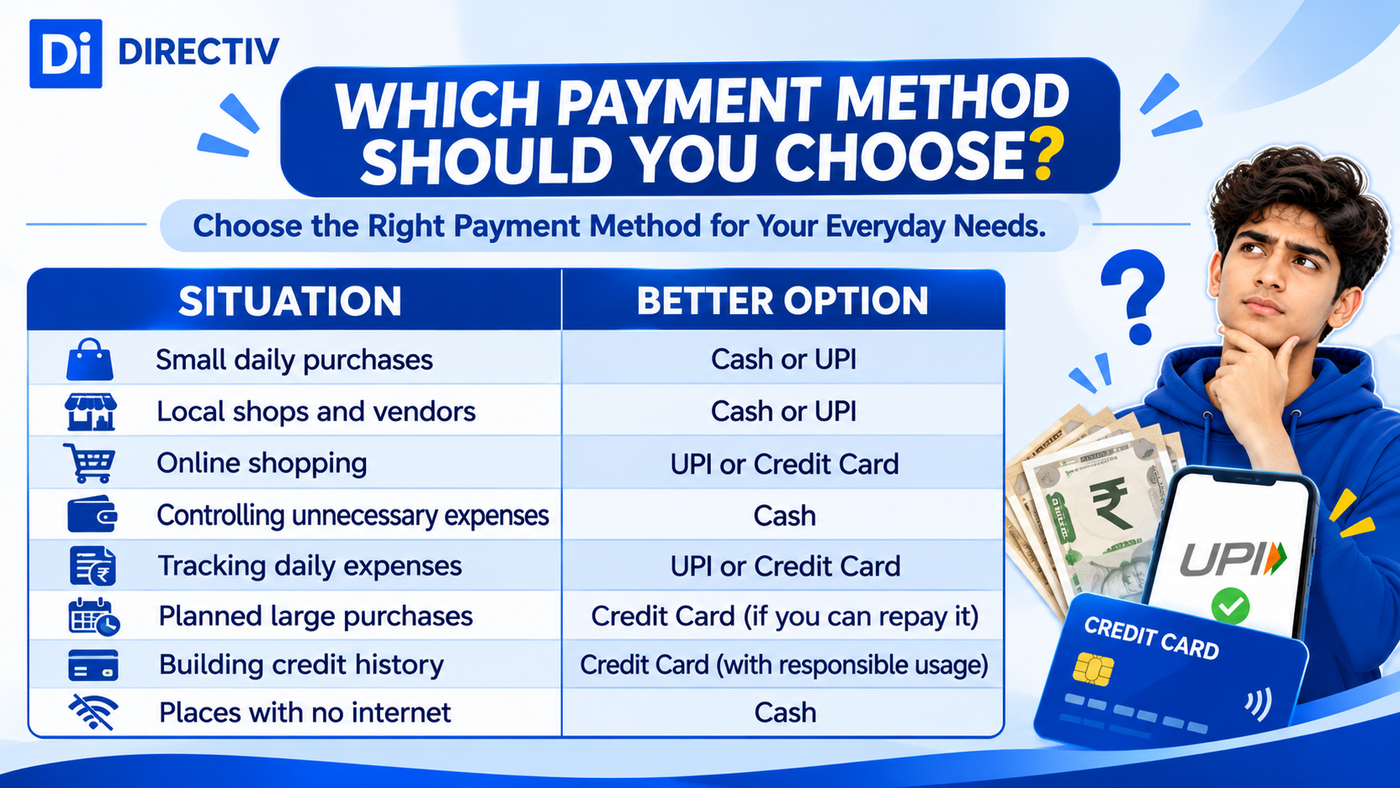
Which Payment Method Should You Use?
There is no single payment method that is best for everyone. It depends on your spending habits and how you manage your money.
How to Avoid Unnecessary Spending
No matter which payment method you use, managing your expenses is important. Here are a few simple things you can follow:
- Set a spending limit: Decide how much you can spend every month.
- Track your expenses: Keep checking your small and large transactions.
- Avoid unnecessary purchases: Don't buy something just because you have an easy payment option.
- Use credit cards carefully: Don't spend more than you can repay.
- Pay your credit card bill on time: Try to pay the full outstanding amount before the due date to avoid interest charges.
Final Thoughts
Cash, UPI and credit cards all have their own advantages and disadvantages. Cash can help you control unnecessary spending, UPI makes everyday payments easier, and credit cards offer rewards and payment flexibility when used responsibly.
At DIRECTIV, we believe that understanding how to manage money is just as important as earning it. The right payment method is not the one that helps you spend more, but the one that helps you manage your money wisely.
So, choose your payment method according to your needs, stay within your budget and make every spending decision carefully. Build better financial habits with DIRECTIV.
Frequently Asked Questions
1. Is UPI better than a credit card?
UPI is convenient for everyday payments, while credit cards offer rewards and payment flexibility. The better option depends on your spending habits and ability to manage credit card bills.
2. Is cash better for controlling spending?
Cash can help you become more aware of your expenses because you physically see the money leaving your hands. It can be useful if you struggle with unnecessary spending.
3. Do UPI transactions affect your CIBIL score?
No. Normal UPI transactions do not directly affect your CIBIL score. Responsible credit card usage and timely repayments can help build your credit history.
4. Is it good to use a credit card for everyday expenses?
Yes, if you stay within your budget and pay your full credit card bill on time. Avoid spending extra just to earn cashback or reward points.
5. What happens if I send money to the wrong UPI ID?
You should immediately contact your bank or UPI app and raise a complaint. However, recovering money sent to the wrong person is not guaranteed.
6. Are credit card rewards and cashback worth it?
They can be useful if you were already planning to make the purchase. But spending extra money just to earn rewards can cost you more than the cashback you receive.
CA Umang Mahra is a Chartered Accountant and co-founder of Directiv, a life-skills learning platform. His expertise includes investing, stock research, business fundamentals, and company valuations. Through his work, he aims to help young learners develop financial literacy, make informed financial decisions, and build a strong foundation for long-term wealth creation.
LinkedIn: https://www.linkedin.com/in/ca-umang-mahra-56a0b4151/
This article is for general educational purposes only and is not personalised financial, investment, tax or legal advice. Please consult a qualified professional before making financial decisions.
Ready to build real-world skills?
Join DIRECTIV and start your journey in finance, content and communication.
Get in Touch