General
5 Steps to Master Communication Skills
By Team DIRECTIV · · 4 min read
5 Steps to Master Communication Skills
Have you ever had a brilliant idea but failed to explain it? Do you get nervous while delivering presentation reports or sharing your ideas with others in group discussions and interviews? Communication skills for students are critical, yet many often have brilliant ideas and sound knowledge of a topic but fail to deliver it due to a lack of practical experience.
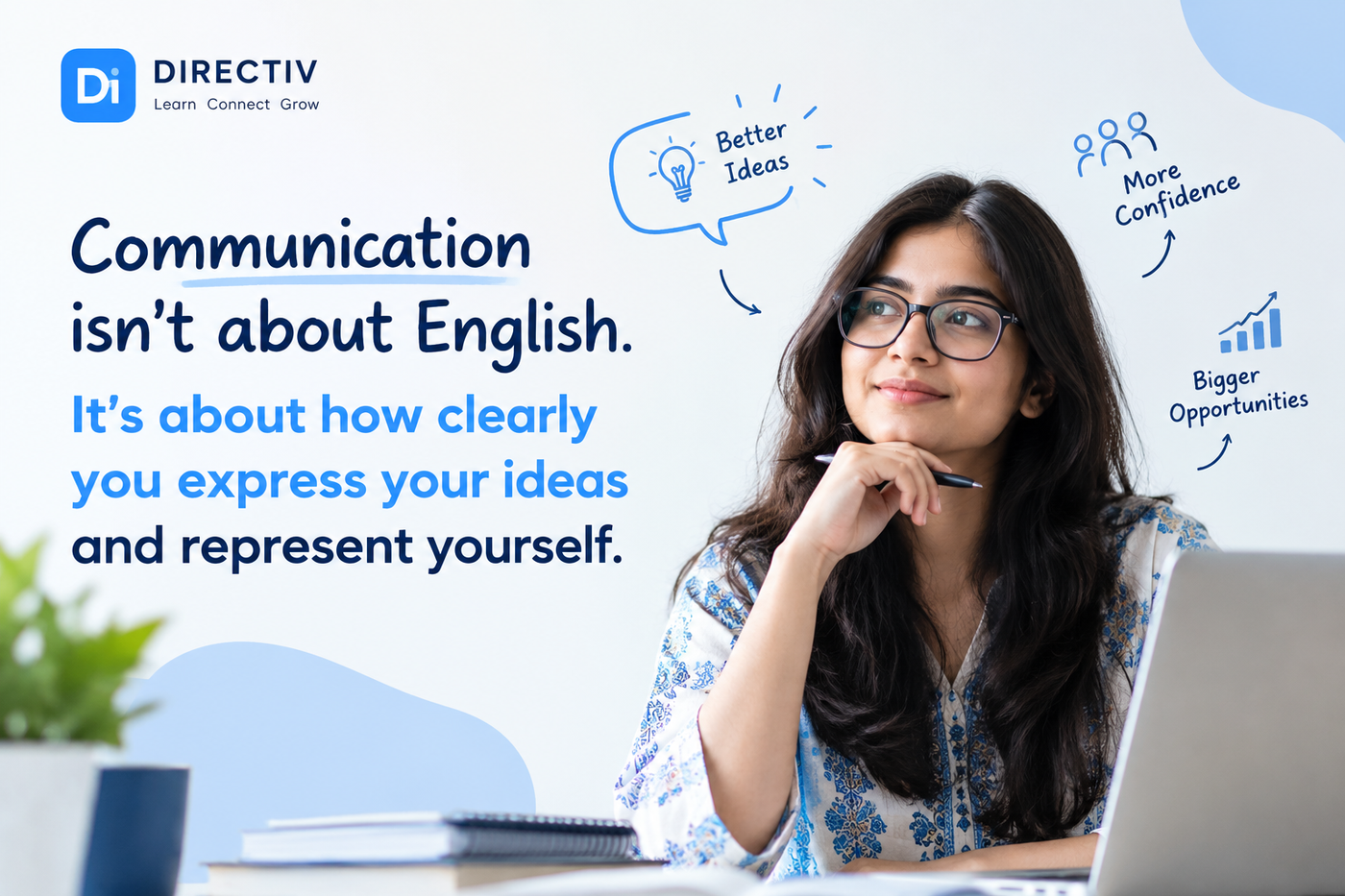
If you are wondering how to improve communication skills, one reason for hesitation could be the misconception that developing these abilities only requires fluency in learning the English language. Students often overlook the fact that effective communication skills also include being able to deliver and present your ideas clearly.
Why Are Communication Skills Important?
According to the US-based National Association of Colleges and Employers (NACE), 96.1% of surveyed employers found communication skills to be critical, of which only 53.5% assessed recent graduates as proficient in this skill. This assessment shows the gap between what business recruiters look for in new graduates and how students are prepared in college. While this study was conducted among US-based employers, it shows how essential communication skills for college students are in addition to their core field of study. Source: NACE — Job Outlook 2025
5 Steps to Master Communication Skills:
1. Focus On Clarity, And Not On English-
To develop effective communication skills, you do not need to be exceptionally fluent in the English language. All you need to do is practice explaining your ideas in the language you are comfortable with and organising your thoughts before practising your delivery in English. World Economic Forum's Future of Jobs Report 2025 lists ‘active listening, empathy, leadership, and social influence’ as some of the most relevant workplace skills. This shows that knowing how to improve communication skills involves much more than just mastering English vocabulary. Source: World Economic Forum — Future of Jobs Report 2025
2. Practice Expressing Your Ideas-
Pick a topic every day and try to explain it to improve speaking skills. Try to identify three key elements — your main point, your reasoning, and an example that supports your point of view. If you find it difficult to organise your thoughts, you can always practice with the help of structured learning. Directiv focuses on developing skills-based learning and explores skill mastery to enable learners to identify and utilise skills outside the classroom.
Read this as well- Best skills to learn in 2026
3. Be an Active Listener-
Listening is an essential part of mastering communication skills for students. Listening attentively and asking clarifying questions help in understanding and responding to others’ ideas accurately. A great way to start practicing being an active listener is by asking one question in your next conversation that will help you understand the other person’s point of view better.
4. Improve Your Body Language-
Your posture, facial expressions, eye contact, and speed of speech can heavily impact how your audience perceives you. To improve speaking skills and non-verbal delivery, practice being comfortable with your body, speaking slowly, and maintaining natural eye contact with your conversation partner. Record yourself speaking for a minute and observe how clearly you speak, your facial expressions, and your overall body language. Choose one area you want to work on and start practising daily.
5. Apply Communication Skills in Everyday Conversations-
The best way to figure out how to improve communication skills is by actively practising them in everyday conversations. You can practice expressing your opinion, introducing yourself, joining group discussions, delivering presentations, and more.
How Directiv Can Help You Develop Practical Skills
While your college education focuses on providing you with knowledge in your specialisation, it does not always teach you how to search for or apply effective communication skills. Communication, along with confidence, active listening, and expressing yourself, can help you be a successful student and graduate. Directiv helps bridge the knowledge and skill gap by identifying essential skills-based learning and exploring the opportunities that come with it. Explore Directiv skill-development opportunities to learn more.
Frequently Asked Questions About :
Q: Where do I actually stand right now?
A: You can evaluate whether your challenge lies in structuring thoughts or in physical delivery by Directiv skill assessment text.
Q: How do I practice this when I don’t have anyone to practice with?
A: You can start by recording short daily videos on a topic, speaking in front of a mirror, or practicing structured exercises on your own. Directiv offers guided learning modules designed to help you build confidence independently before stepping into group discussions.
Q: How do I handle high-stakes situations like interviews or placement drives? A: Prepare by structuring your responses using proven methods like the STAR framework (Situation, Task, Action, Result) and practicing a 60-second elevator pitch.
Ready to build real-world skills?
Join DIRECTIV and start your journey in finance, content and communication.
Get in Touch